




Hi everyone! My name is Anna, and I am one of the physiotherapists at our SOS Physiotherapy Northfield location. Today, I am excited to share with you my recent trip to Punta Cana this past June.
Wow, what a week! If you are wondering why I decided to visit quite a hot country during this season, I had friends’ destination wedding I could not miss. I will say, despite the heat, this beautiful beachside location was perfect for the special occasion. The wedding itself was amazing, with stunning ocean views and a touching ceremony. In the evening, we had a great time celebrating the happy couple at the reception, enjoying great food and hitting the dance floor.
Nonetheless, the week was not just about the wedding. My friends and I made the most of our time together in Punta Cana with different activities at the resort and in the local town. For those who just wanted to relax (aka myself), the resort’s pool/beach and spa were perfect. With the ocean just a few steps away, we spent hours lying on the beach to cool off with the little breeze by the water and palm trees. The beach was definitely our daily escape! Beside the resort, we were able to visit the local city. The best part about the city was trying local street food and wandering through colorful markets.






Despite the intense heat, the week was filled with so much joy and laughter. Our time in Punta Cana went by very fast, and it was hard to say goodbye. This trip was not just about a wedding, it was about creating beautiful memories that we will all cherish forever.




Does stress cause neck pain? The short answer is no! At SOS Physiotherapy, we like to say “contributes to” instead of “cause.” The casual way healthcare professionals throw around terms can lead to confusion and, worse still, ineffective treatment. Fortunately, our highly skilled therapists know how to dig deep and find the root cause of your neck pain, and this information helps you find relief!
Let’s discuss Nicole, a 40-something-year-old working mother of three. Nicole was used to being very active, balancing her work schedule with getting her kids to all the various activities and school functions that come with being a mom nowadays.
Her neck pain first started as a crick in the neck when she woke up one morning. As the day progressed from driving her kids around to sitting at her desk, she noticed turning her head became more difficult and painful, making focusing on work nearly impossible.
Nicole struggled to figure out why her neck started hurting and came to the conclusion that stress “must be” the culprit. The more pain and difficulty moving she had, the more convinced she was that stress was to blame.
Understanding Nicole’s Neck Pain
One of the most common things we hear from our patients is that their pain started for “no apparent reason.” Like Nicole, people will wake up with a crick in their neck or notice a stiffness turning when driving in the car. It is also common for people to notice tightness in their upper back and neck after a long day.
So, what is actually the source of the pain? In most cases, there is an issue with the neck joints or the neck muscles due to prolonged positions. Our neck joints don’t like remaining in any position for extended periods. In Nicole’s case, she first noticed her pain in the morning, which may have been related to her neck position while sleeping. It is also important to note that in Nicole’s case, the first sign of any issue was in the morning when she woke up, unrelated to stress.
As Nicole’s day progressed, her pain got worse. But this also was more likely related to how she held her neck while driving or sitting at her computer. In both cases, her posture, specifically how she held her neck, seems to have contributed to her pain. Prolonged sitting can lead to a forward head position, resulting in tension to soft tissue (i.e., muscles, tendons, and ligaments) or negative changes to our blood flow.
The muscles of our neck function best when we move them. So, holding her head in one position likely led to irritation of the muscles and affected her ability to move her neck, which in turn caused stress.
Stress “contributes” to neck pain because, when we experience stress, our bodies naturally respond by tensing up as a protective measure. This tension can lead to discomfort, particularly in the neck and upper back region. Research studies have found that individuals with higher stress levels reported increased neck pain as compared to those with lower stress levels. This is why we say “contributes” to, but not the cause of, neck pain.
How Physiotherapy Can Help Alleviate Neck Pain
We will target the source of your pain by performing a thorough examination, starting with your medical history and details about how, when, and where your symptoms began. As we saw with Nicole, determining how, when, and why the pain started helps us eliminate possibilities and get to the actual root cause(s).
Our therapists will also analyze your posture and movement to identify any limitations or restrictions contributing to your condition. We’ll use this information to design a program that addresses your specific needs.
Our treatment plans focus on relieving your pain and improving your posture, mobility, strength, etc., and educating you about managing your symptoms. Your program will likely include manual therapy (i.e., soft tissue work and/or joint mobilizations), targeted stretches, exercises, activity modification, or posture recommendations.
We’ll listen to your unique situation and specific issues and then work to help you find relief and get back to your normal routine.

If you’re dealing with neck pain or looking for someone to help you figure out what is causing your issues, call us today and set up a consultation!






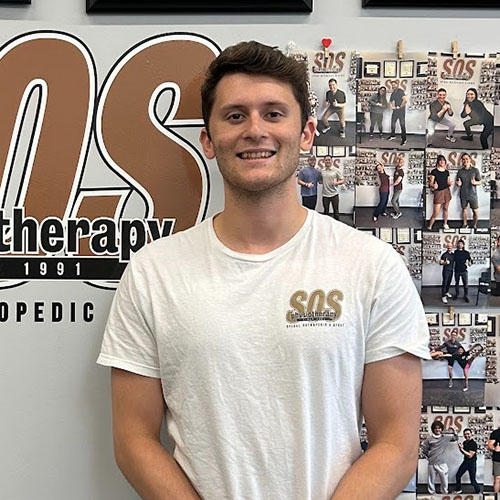
Hi SOS! My name is Brett, and I’m a third-year co-op student at the University of Waterloo. This is my second placement at SOS; I did my first stint at SOS Elmira, and I’m currently working at SOS Northfield. When the opportunity to work at another SOS clinic came my way, I couldn’t pass up the chance to join this team again. The collaborative environment that SOS fosters is very inviting for a student like myself. My favorite thing about my time at SOS has been the mentoring sessions in which students get to ask questions, practice hands-on treatments & truly learn what it takes to be a great physiotherapist!
Outside the clinic, you will often find me at football practice with the University of Waterloo as we prepare for the next season. Balancing my time between academics, co-op placements, and athletics can be challenging, but it’s also very rewarding. I am grateful for the hands-on experience and mentorship provided by the team at SOS, which not only enhances my technical skills but also shapes my understanding of patient care! This placement has solidified my passion for healthcare, and I look forward to continuing my journey at SOS!
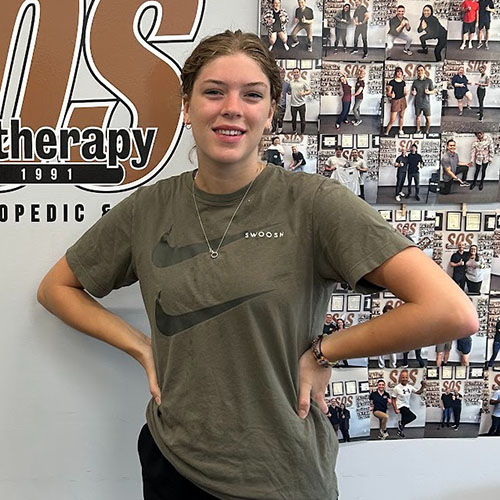
Hi, my name is Kaelyn Vanderniet and I am a 3rd year kinesiology student at the University of Waterloo! This summer I am completing my 2nd co-op term with SOS at their Northfield location. You can find me at the front desk or lending a hand around the clinic. Feel free to say hi when you see me around. I love to chat about rock climbing, the outdoors and your latest adventures! I love working with the SOS team and look forward to the opportunities this job provides. I’ll see you this summer!
Salmon Burgers

• 1 cup finely chopped red onion
• 1/4 cup thinly sliced fresh basil
• 1/4 tsp salt
• 1/4 tsp freshly ground black pepper
• 1 pound salmon fillet
• 1 tbsp hot pepper sauce
• 1 large egg white
• Cooking spray
• 8 slices focaccia, toasted
Combine first 5 ingredients in a large bowl. Combine hot pepper sauce and egg white in a small bowl; add egg white mixture to salmon mixture, stirring well to combine. Divide the mixture into 4 equal portions, shaping each into a 1/2-inch-thick patty. Heat a large nonstick skillet over medium-high heat. Coat pan with cooking spray. Add salmon patties, and cook 3 minutes on each side or until desired degree of doneness. Serve patties on toasted focaccia.
Treat Golfing Injuries with Physiotherapy
Are you concerned about an old injury that seems to pop up every golf season? Have you wondered what to do to get ready for golf this year? At SOS Physiotherapy, our physiotherapists are highly trained movement experts. We can help figure out any limitations or restrictions that may be affecting your swing or causing you pain.
Request an appointment at SOS Physiotherapy today and let one of our physiotherapists assess how your body moves. We’ll teach you how to resolve any issue standing in your way of getting out on the course again!
Most common injuries in golf
Although often thought of as a leisurely activity, golf requires considerable coordination, which can sometimes result in injury. The most common type of injury is overuse due to the repetition of swings and, even worse, poor technique.
The most common injuries in golf occur to the following areas of the body:
• Lower back: Improper swing technique is one of the leading causes of lower back pain among golfers. Swinging too forcefully and/or with too much or too little motion can lead to muscle strains and abnormal pressure on the spine’s discs.
This is particularly important for senior golfers who have lost spinal mobility as they get older.
• Neck: New golfers, in particular, are not used to twisting their bodies as far or as many times as a round of golf requires. Although the head should stay relatively still while swinging, the movement of the rest of the spine causes rotation of the neck from the bottom up instead of our usual top-down sensation.
You can sometimes avoid neck pain or injuries by first warming up properly, taking frequent breaks, starting with fewer holes in the beginning, and slowly working up to more extended periods of practice and play.
• Shoulder: Shoulder pain and injury can occur at any phase of the golf swing but tend to be due to faulty swings, a traumatic force like hitting a root or rock, taking a deep divot, or fatigue and overuse.
Golfers typically develop problems with their tendons (i.e., rotator cuff muscles) or degenerative and arthritic changes to the joints. Fortunately, most injuries respond to physiotherapy intervention.
• Elbow: Golfer’s elbow is a common issue for golfers. It is a form of tendinopathy that causes inflammation or micro-tearing in the tendons surrounding your elbow’s inner aspect. This condition is often the result of repetitive gripping and/or swinging and may be related to grip on the club handle. This condition can make holding and swinging a club impossible.
• Hip: The hip joint typically has a lot of mobility and can withstand large amounts of forces. The hip is subjected to repeated stresses during the golf swing and is particularly vulnerable to injury.
• Knee: Knee pain is one of the most common types of injuries in the lower body of a golfer. The most common type of knee injury amongst golfers is a meniscal tear. This injury may be caused by sudden, forceful, twisting motions while bearing weight through the knee.
At SOS Physiotherapy, our therapists thoroughly understand movement and specifically the biomechanics of a golf swing. We use our expertise in the musculoskeletal system to identify and manage golf injuries. Our goal is to help you recover from an injury and improve your overall movement and strength so you can get back on the course doing what you love!
What to expect at your physiotherapy sessions
The physiotherapists at SOS Physiotherapy have an excellent understanding of the biomechanics and forces of the golf swing and can diagnose and treat any musculoskeletal injury.
At your first visit, we will perform a comprehensive evaluation that includes a thorough history and movement assessment. We will determine your specific joint range of motion as well as how your joints move in relation to one another.
Furthermore, we will assess your strength, coordination, and balance to identify any weaknesses and/or limitations that may limit your ability to swing correctly.
This information will help us design a program tailored to your individual needs. This program will consist of flexibility/mobility, strength, and power training with correction of faulty movement patterns to help the golfer reduce the likelihood of injury and improve their overall performance. Our team will also demonstrate proper warm-up routines to ensure you’re moving safely.
At SOS Physiotherapy, we are proud to offer a return to sports training program. This functional training program can help athletes like you return to play after surgery or a serious injury.
Our program pushes athletes to utilize multiple muscle groups at once, which in turns allows the athlete to move fluidly. Whereas traditional forms of training only work muscles in isolation.
Request an Appointment Today
At SOS Physiotherapy, our physiotherapists will design a golf-specific plan to help you find relief and protect your body from future injuries and pain. No matter what condition you are dealing with, we can help you golf pain-free!

Let’s Get You Better ASAP!
Don’t let pain dictate your life. Take the first step towards reclaiming your mobility and well-being with our expert support. Start your journey to a healthier you today.