



All American Road Trip – Canadian Style
By Gordon Restivo, a Registered Physiotherapist at our SOS Elmira location
From London Ontario to the Pacific: My 8,000km Road Trip Across America
This past year, I was fortunate to take multiple trips across the world. And while I don’t currently have any travel plans on the horizon, I find a lot of joy in looking back at some of those journeys, to keep them fresh in the mind and close to the heart.
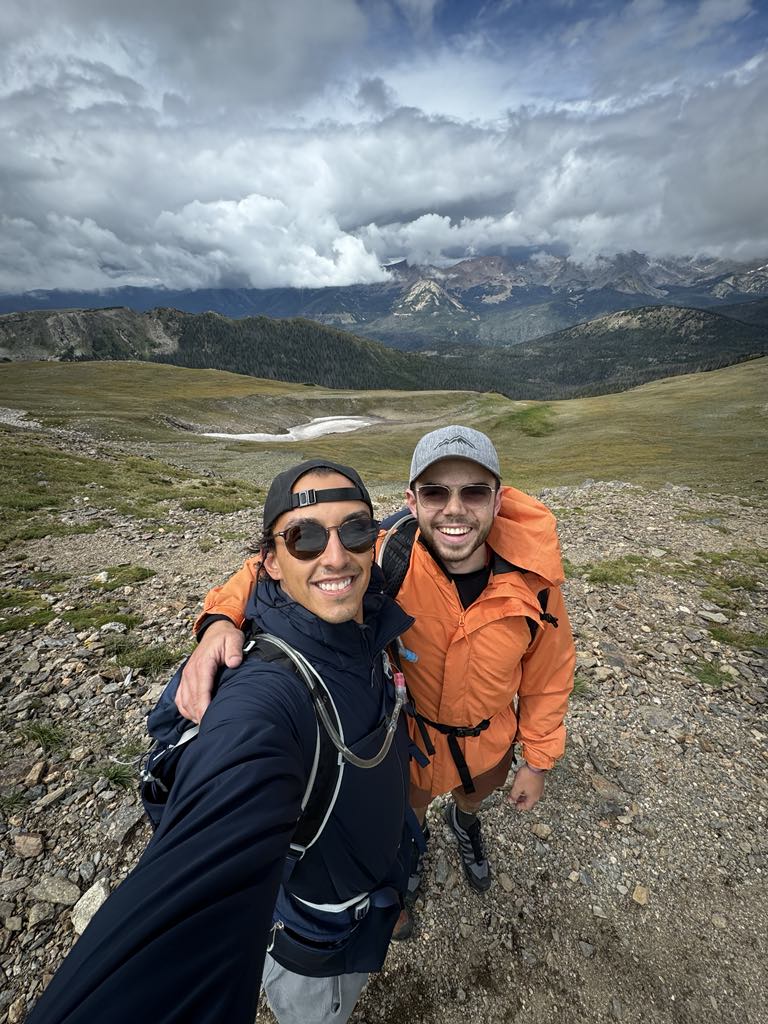
One of the most memorable was an 18-day road trip I took last summer across the U.S. with a good friend I met during physiotherapy school. In total, we drove over 8,000 kilometres, starting from London, Ontario, all the way to the California coast, and then up through the Pacific Northwest to Vancouver, BC.
The Route: We hit five major cities
Chicago (for deep dish and music), Denver (gateway to the Rockies), Las Vegas (which felt like walking on the sun), Seattle (coffee and coastal fog), and Vancouver (a perfect finale).
Along the way, we visited eight national parks, each offering its own unforgettable landscape:
Rocky Mountain National Park, Arches (stoney arches scattered across the red rock landscape), Zion (The Angel’s landing hike left us in awe as the sun rose over the valley), Grand Canyon (So vast I couldn’t begin to comprehend its beauty), Yosemite (Rolling granite cliffs as far as the eye could see), Sequoias (towering redwoods and the largest tree in the world), Redwood (beautiful west coast beaches and rainforests), Olympic (A striking mountain against the brig),
A Few Highlights
The Grand Canyon was a surreal sight to see. So vast and awe-inspiring that I genuinely didn’t know how to process it. It’s a place so big, it almost feels abstract. Pictures don’t do it justice.
Yosemite was, without question, my favourite park of the trip. Towering granite cliffs, alpine meadows, and ancient sequoias. It felt like a movie set brought to life. We tackled the Half Dome hike, which tested both body and spirit. After 10+ hours of hiking, 40,000 steps, and a harrowing stretch up a 70 degree angled cliff, the half-dome hike remains the most vivid and fond memory I have from the trip. By the end, I had even developed some mild Achilles tendinitis (yes, even physios can get injured when they overdo it!).
Las Vegas brought the heat…literally. We walked the Strip at night in 40°C heat, surrounded by neon lights and surreal energy. It was intense, fun, and just a little bit dehydrating.
The Experience
The road trip lifestyle was as memorable as the destinations themselves. We often had no idea where we’d be sleeping the next night. Sometimes we camped in national parks, sometimes we found hostels, and other times we set up on Bureau of Land Management land under the stars.
There were hours spent in the car, windows down, listening to music, sharing stories, and having the kinds of deep or ridiculous conversations that only happen on the open road.
It wasn’t always glamorous, with some nights being cold like in the 4°C at the tips of the Rockies, some mornings we woke up sore, and occasionally we didn’t eat anything besides trail mix and gas station snacks, but it was a real and authentic life experience. And it was worth every minute.



Physiotherapy Can Help You Resolve Unwanted Knee Pain
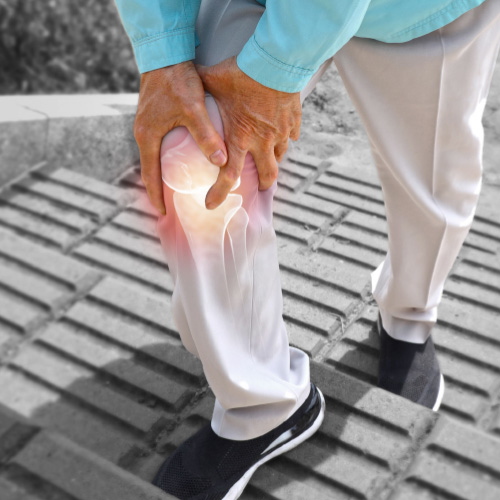
Do you experience pain and swelling with squatting or climbing stairs? Do your knees often catch or lock up, making it difficult to perform daily tasks that once seemed simple? At SOS Physiotherapy, our physiotherapists can help you find relief and get you moving again!
Knee pain can be debilitating, making it difficult to walk, run, and move. It may even hinder your ability to do simple things like sitting through a movie or a long car ride. The location of your pain helps determine which structures are involved and can help ensure proper treatment.
Often the pain leads to avoiding activity, but this strategy does not help in the long run. Inactivity often leads to more dysfunction and disability. Physiotherapists are movement experts, and if your symptoms are severe or last more than a few weeks, your first step should be to contact our physiotherapists!
At SOS Physiotherapy, we can get you moving once again by relieving your pain and enhancing your body’s natural healing process. Call today to schedule an appointment with one of our experts!
What are the Most Common Knee Injuries?
Your knee is one of the largest joints in your body, made up of a complex system of bones, tendons, and ligaments. Knee injuries can result from direct contact or a sudden movement that strains the knee. When there is no specific event connected to the damage, the most common knee pain causes are aging, injury, or repeated stress on the knee.
Knee pain can be mild or severe and includes sprained ligaments, cartilage tears, tendonitis, and arthritis.
Some other common causes of knee pain include:
Arthritis: The most common type of arthritis for knee pain is osteoarthritis (OA). This condition occurs when the cartilage surrounding your joints deteriorates, and the joint no longer has a sufficient cushion between the bone. This leads to joint inflammation with varying levels of pain and dysfunction.
Cartilage Injuries: There are two common cartilage injuries:
- Meniscus injury: The meniscus serves as a shock absorber and helps maintain stability in the knee. A meniscus tear can be caused by contact or non-contact activity when the knee twists suddenly. Some tears are the result of wear and tear.
- Articular cartilage injury: The articular cartilage is a smooth covering on the bones that allows for frictionless sliding of one bone on another. Articular cartilage is injured by direct trauma or wear and tear.
Ligament Injuries: Our bones are connected by ligaments. The ligaments in your knee act like leather straps to hold the bones together and keep your knee stable. Ligaments are often stretched and/or torn during a sudden motion. The important ligaments in the knee include:
- Anterior cruciate ligament (ACL). It is located in the center of the knee and controls rotation and forward movement of the shin bone.
- Posterior cruciate ligament (PCL). It is located in the back of the knee and controls the backward movement of the shin bone.
- Medial collateral ligament (MCL). The medial collateral ligament is on the inside of your knee and provides stability to sideway motions.
- Lateral collateral ligament (LCL). The lateral collateral ligament is on the outside of your knee and provides stability to the sideways motions.
Tendonitis: Your tendons are thick connective tissues that attach muscles to bones. Tendonitis occurs when the tendon becomes inflamed due to repetitive movements. It is common with jumping and landing motions and also in sports like skiing, cycling, or hurdling.
Knee pain can make it hard to walk, rise from a chair, climb stairs, or play sports. Our physiotherapists are trained to diagnose and treat knee pain, help ease your pain and get you back to doing what you love!
How Physiotherapy Can Help Your Knee Pain
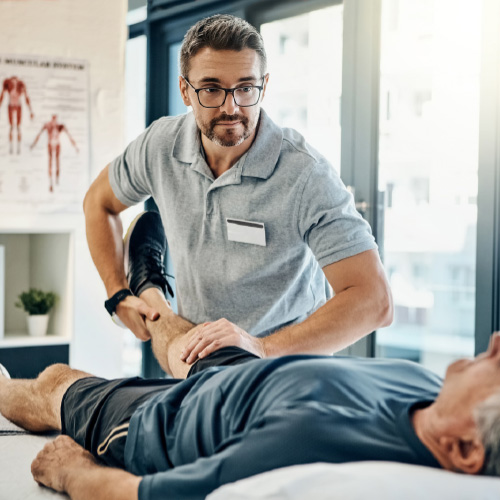
Physiotherapy for knee pain involves a thorough assessment of your entire lower extremity, including your hip, knee, and foot. Our team will examine your knee for signs of misalignment or structural damage and assess your stance, gait, and functional movements like squats and steps. Your therapist will prescribe the right treatments — including exercises, manual therapy, and modalities — to help decrease your knee pain and improve overall mobility.
We will provide you with a supervised, progressive program to get you moving again. Our programs to reduce pain and restore function consist of range-of-motion, strength training, proprioception, and neuromuscular control activities.

Contact Us Today!
If you are living with knee pain, contact SOS Physiotherapy today. We’ll help relieve your pain so you can get back to living your life comfortably, without limitations!
Mentoring Corner
At SOS Elmira
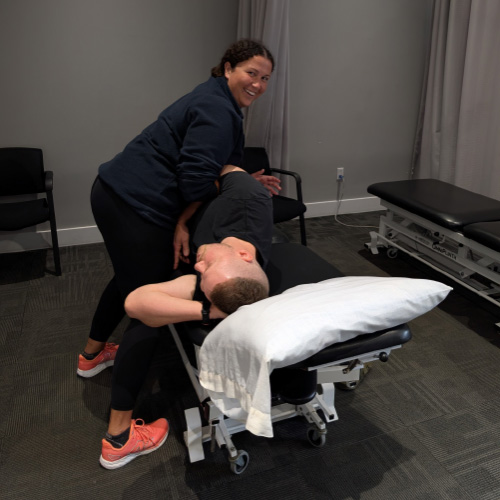
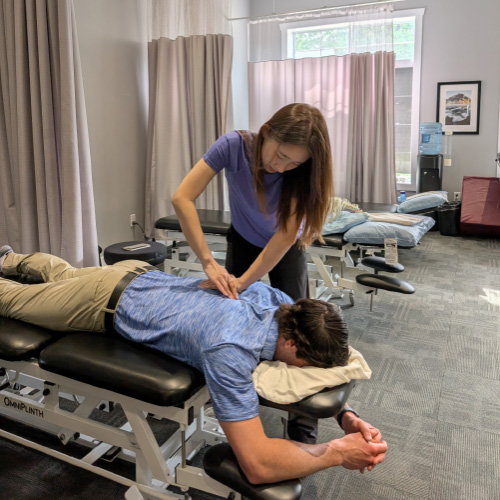
At SOS Physiotherapy Elmira, we’re proud to support the next generation of physiotherapists through hands-on mentorship and weekly clinical development sessions. Every Thursday, our team carves out time to practice manual techniques, review treatment strategies, and reflect on cases from the week. With multiple students currently completing placements at our clinic, these sessions are a great opportunity to blend education with real-world clinical experience.
This week, our focus was on the thoracic spine, a key area that supports movements like reaching overhead, maintaining upright posture, and proper shoulder function. Pictured below is Lucy, a physiotherapy student from Western University, practicing a thoracic extension mobilization to improve mid-back mobility. Techniques like this are essential in helping patients move and feel better in their day-to-day lives.
Student Life at SOS
Meet Lucy!
At SOS Physiotherapy, we place a high value on student experience, hands-on learning, and mentorship. We proudly offer a range of student placements, including positions for physiotherapy students, undergraduate volunteers, and co-op participants.
Currently, at our Elmira location, we’re excited to have two new physiotherapy students joining our team and contributing to patient care as part of their clinical education.
Maddy is a familiar face at SOS Elmira, formerly an employee, she has returned after spending the last two years completing her Master’s degree in Physiotherapy at the University of Cumbria in the UK.
Lucy is a Master’s student from Western University in London, Ontario, completing her first-ever placement right here at SOS.
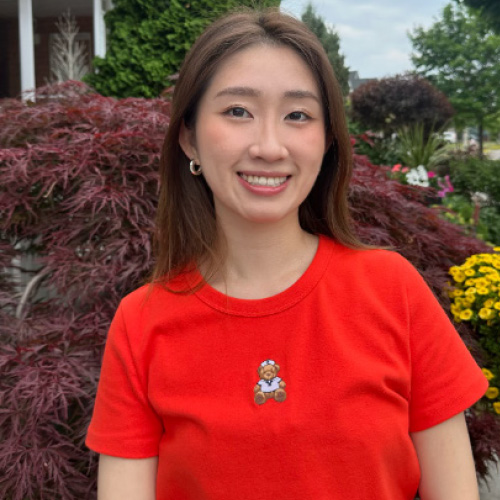
Here’s a little more about Lucy, her background, and how her experience at SOS has been so far:
Hi everyone! My name is Lucy, and I’m the new physiotherapy student here at SOS Elmira, currently completing my first-ever placement in the program!
A little bit about me… I grew up in Richmond Hill, Ontario, and completed my undergraduate degree in Kinesiology at the University of Toronto last summer. In my spare time, I love building puzzles and LEGO sets, as well as going on bike rides with my friends! It’s my first time in Elmira, and I’m already enjoying this quiet, slower-paced town.
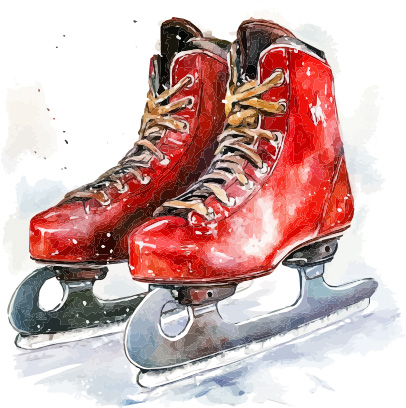
What inspired me to pursue a career in physiotherapy is my love for figure skating. Even though I’m just an amateur skater, I’ve always had a deep interest in the sport, especially thanks to my favourite figure skater, Yuzuru Hanyu, who used to train in Toronto. Unfortunately, he retired in 2022 and no longer comes to Canada. Nonetheless, my passion for physiotherapy has only grown since then.

Peanut Chicken Protein Bowls
Ingredients:
- 1 large sweet potato, peeled, cut into 1/2” cubes
- 1 large red onion, finely chopped
- 3 Tbsp. extra-virgin olive oil, divided
- Kosher salt
- Freshly ground black pepper
- 2 (6- to 8-oz.) boneless, skinless chicken breasts
- 1/2 tsp. garlic powder
- 1/2 tsp. ground ginger
- 1 small garlic clove, finely chopped
- Juice of 1 lime
- 2 Tbsp. creamy peanut butter
- 1 Tbsp. honey
- 1 Tbsp. reduced-sodium soy sauce
- 1 Tbsp. toasted sesame oil
- 4 cups cooked brown rice
- 1 avocado, thinly sliced
- 2 cups baby spinach
- 1 Tbsp. finely chopped fresh cilantro
- 1 tsp. toasted sesame seeds

Directions:
Arrange a rack in center of oven; preheat to 425°. On a large baking sheet, toss potatoes and onion with 1 Tbsp. olive oil; season with salt and pepper. Bake potatoes until tender, 20 to 25 minutes. Meanwhile, in a large skillet over medium-high heat, heat 1 Tbsp. olive oil. Season chicken with garlic powder, ginger, salt, and pepper. Cook chicken, turning occasionally, until golden brown and an instant-read thermometer inserted into thickest part registers 165°, about 8 minutes per side. Transfer to a cutting board. Let rest 10 minutes, then thinly slice. In a small bowl, whisk garlic, lime juice, peanut butter, honey, and soy sauce. Whisk in sesame oil and remaining 1 Tbsp. olive oil until smooth. Divide rice among bowls. Top with potato mixture, chicken, avocado, and spinach. Sprinkle with cilantro and sesame seeds. Drizzle with dressing.
How Long Until I’m Better?
One of the most common questions I get as a physiotherapist is “How long is this going to take until I’m better?”
Of course! That makes sense. Uncertainty and pain are scary. It’s natural to want a clear, concrete timeline for recovery. A black-and-white answer to put the worry to rest. But here’s the honest truth:
The human body is incredibly complex, and healing is almost never a straight line. There is rarely a one-size-fits-all answer. Recovery depends on many variables, not just the injury itself. Other factors come into play, like how you move, rest, fuel, and support your body every day.
It’s Not Just About Time
Recovery isn’t about passively waiting for things to get better. It’s an active process. If you want to maximize your healing, it helps to look beyond the injured area and focus on the full picture.
At SOS Physiotherapy, we’re always working with patients to maximize recovery by addressing all of its key elements:
Strength
Building strength in surrounding tissues supports and protects the healing area. Strength gains typically happen in two phases:
- Neuromuscular gains (2-4 weeks): Your nervous system becomes more efficient at activating muscles.
- Muscle growth (6-12+ weeks): True hypertrophy requires consistent loading at least 1-2 times per week, along with adequate rest and nutrition.
Mobility
Regaining range of motion can be an important aspect of recovering from many musculoskeletal injuries. While short-term improvements can be seen right after performing mobility exercises, lasting change takes time. Passive stretching alone usually isn’t enough. Often you will need active, strength-based movement to “lock in” mobility gains.
Specificity
Your rehab should mimic the exact movements you’re returning to. Whether it’s hiking, lifting, running, or your job duties, exercises should be tailored to your needs.
Stress
Both chronic and transient stress can increase pain sensitivity and slow healing. Managing stress is a critical but often overlooked part of rehab.
Sleep
Your body heals when you rest, especially during sleep. Poor sleep can slow your recovery time.
Nutrition
Nutrient-dense foods and adequate protein intake support muscle repair and tissue healing. Think of food as fuel for recovery.
Hydration
Muscles, tendons, and joints are mostly water. Dehydration can reduce elasticity, increase friction in joints, and make tissues more prone to stiffness and pain. Make sure to drink plenty of fluids consistently throughout the day.
A Word of Caution
One of the biggest mistakes I see is people starting to feel a bit better and jumping straight back into full activity. This is definitely understandable, as we’re all eager to get back to the things we love. But without a gradual return that mimics the demands of your sport, job, or lifestyle, it’s easy to set yourself back or even cause a re-injury.
So… How Long?
Here’s the best answer I can give: it depends. At SOS we’ll make sure you’re progressing as efficiently and safely as possible. Our job isn’t just to help you recover, it’s to guide you through the messy, unpredictable parts of healing. Human bodies aren’t machines, and we all respond a bit differently.
If you’re wondering where you are in the process, or what you can do to help your recovery progress more efficiently, don’t hesitate to book a free discovery session at any of our SOS Physiotherapy clinics.