


Boston in Motion
By Adam Hanton-Fong, Physiotherapist at our Northfield Location
Hey there! When I’m not in the clinic helping people move and feel their best, I love staying active while exploring new places — and last November, I had the chance to do just that on a trip to Boston with my partner to visit a close friend from university.
Luckily we arrived and departed just before the U.S. elections, catching Boston in a lively, colourful and energetic fall scene.
Day 1: Fenway & First Impressions
We kicked things off with a tour of the famous Fenway Park, even though the Boston Red Sox were in their off-season. Standing on the Green Monster and walking through the iconic stadium was a great way to feel the history of sports in Boston. I even got to observe the stall that Derek Jeter would always grab when visiting as a New York Yankee.
Day 2: Walking Tour, Food and Harvard Hockey
The next day, we explored the historic Faneuil Hall and Quincy Market for some classic “lobstah rolls” and “clam chowdah” — definitely a must-try. We then made our way to the Freedom Trail, following the red-brick path downtown that guided us through important American History landmarks relating to the Boston Tea Party and independence movement.
That evening, we went to Harvard to catch an NCAA hockey game. This game was action packed and it was a cool experience to compare the style of play vs our Kitchener Rangers.
Day 3: Biking, Bruins, and Bell in Hand
We started our morning renting bikes and took a ride along the Charles River, stopping by MIT and Harvard for some scenic views. The weather was perfect for biking, and we made our way toward downtown as the sun started to set. From there, we went to the TD Garden to watch the Boston Bruins play the Seattle Kraken.
Being a Leafs fan, I won’t say it was easy to be in a sea of black and yellow—but I have to admit, the game was high-energy, and it was fun to experience the chants of “C’mon Marshyyy” in the crowd. Afterwards, we grabbed drinks at the Bell in Hand Tavern, America’s oldest continuously operating tavern (since 1795!).
Day 4: City Views, Boston Public Library and a Sweet Farewell
On our last day, we wrapped up our trip with one last stroll around the city before heading home. We visited the Prudential Center lookout, where we had an incredible view of the entire city. Afterward, we stopped by the Boston Public Library, where the grand halls and quiet corners offered a peaceful contrast to the busy city streets and the high-energy sporting events we’d experienced throughout the trip.
This trip reminded us that staying active can come in many forms, whether it’s exploring a new city, biking along the river, or catching an exciting game—movement and adventure go hand in hand.









How Physiotherapy Can Help You Get Active Again

Do you feel sluggish or tired? Is it difficult to motivate yourself to get moving?
Your body may be experiencing physical problems that physiotherapy can help. At SOS Physiotherapy, our physiotherapists are skilled at finding physical limitations and teaching you the skills to overcome them!
Living a sedentary life is one of the main reasons people report having low energy and feeling day-to-day aches and pains. Sedentary lifestyles increase the risk of cardiovascular diseases, diabetes, obesity, osteoporosis, and joint and muscle dysfunctions, leading to a higher risk of falls.
While it may not seem like it is making an impact at the moment, a sedentary lifestyle can damage your body over time. Fortunately, physiotherapists are experts at addressing old and new injuries that may have led to difficulties staying active. We can design a program tailored to your individual needs to help you get back on track!
How Does a Sedentary Lifestyle Affect Your Body?
People often spend their life with a long commute to work, sitting at a desk all day, and then at home watching T.V. all night.
An inactive lifestyle has the following effects on your body:
• You burn fewer calories which makes you more likely to gain weight.
• You lose muscle strength and endurance.
• Your joints become stiffer and more prone to degenerative changes.
• Your bones may get weaker (i.e., osteopenia and osteoporosis).
• Your immune system may not work as well, making you more susceptible to illness.
• You have poorer blood circulation.
• Your body has more inflammation which makes you more susceptible to aches and pains.
When you don’t participate in frequent physical activity, your body starts to weaken, and as time goes on, it breaks down, making you more prone to disease, injuries, and falls. These consequences can cause severe pain and may result in a host of other problems if lifestyle changes are not made.

How Physiotherapy Can Help
Our physiotherapists see the effects of sedentary life in the form of aches and pains, joint or muscle dysfunction, and injuries from falls or other preventable accidents. We are experts at assessing the musculoskeletal system to address the dysfunctions and adverse health effects created by a sedentary lifestyle.
Our therapists will provide a program tailored to your individual needs and educate you on a safe and effective way to resume an active lifestyle. Our focus will include:
Identifying your prior level of fitness. This requires ongoing discussions about what your typical day was like when you felt your best. Next, we will determine how much movement you get on a typical day at work, at home, and in the community.
Teaching you about the consequences of being sedentary. Education is a crucial component of success. We will show you ways to increase movement in your day and help you make choices that support your well-being.
Develop and progress you through specific exercises. Every program is designed based on your needs. Learning how to safely move without injury or pain is a significant part of our physiotherapy programs. We use objective measurements to determine the level of strength and fitness and build your program accordingly.
From start to finish, we’re dedicated to your ongoing well-being. On every level, physiotherapy serves to enhance your quality of life.
What to Expect in Physiotherapy
To be healthy, you need to emphasize movement. When your body is flexible, strong, and mobile, it can perform at its optimal levels.
Your physiotherapist will assess your particular condition to identify the contributing factors and address all of them. Regardless of the cause of inactivity, physiotherapy plays a significant role in helping you get moving again and should be the first step.
Your therapist can educate you on how regular physical activity and individualized exercise programs can reduce your pain, prevent the condition from worsening, and improve daily function.
In many cases, physiotherapy can help you choose specific exercises and design appropriate strengthening exercises that improve your function without aggravating your pain. Your therapist can help you reclaim a healthy lifestyle.

Schedule an Appointment Today
At SOS Physiotherapy, we are dedicated to helping you live the best life you can.
If you are looking for assistance in living a more physically active life, call today to schedule an appointment with one of our physiotherapists.
In the Community
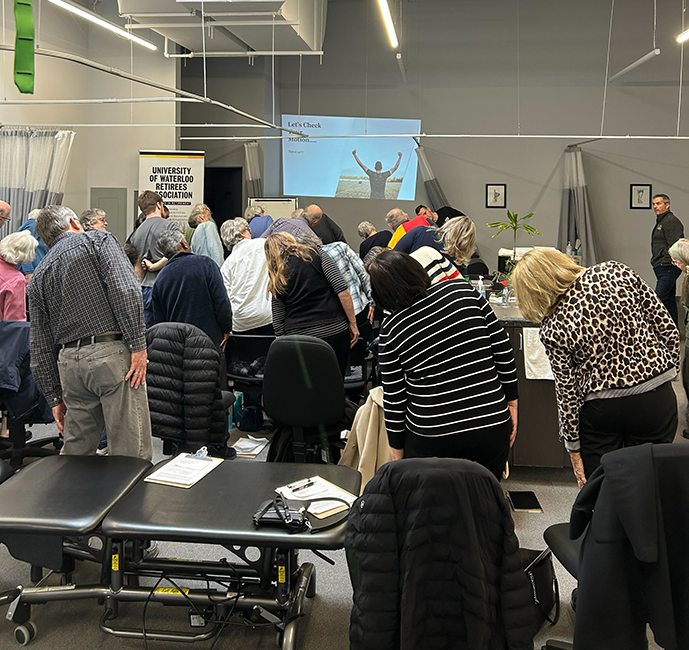
Earlier this month, our physiotherapists Ryan Wark and Jon Clay had the pleasure of leading a workshop on low back pain for members of the University of Waterloo Retirees Association.
The session focused on common causes of low back discomfort, strategies for pain management, and practical exercises that can help maintain mobility and strength. Ryan and Jon also took time to answer questions and demonstrate safe movement strategies tailored to the needs of older adults.
We’re proud to be a part of a community that values lifelong wellness, and grateful for the opportunity to share knowledge that empowers people to stay active and independent.

Ryan Wark
BA (HKin), MPT, CIDN- Partner and Clinical Director

Jonathon Clay
BHSc(PT), BASc(Kin),
FCAMPT- Partner
A Commonly Forgotten Shoulder Muscle:
The Serratus Anterior and its Impact on Scapular Winging
by Physiotherapist Adam Hanton-Fong
One of the more commonly overlooked muscles when it comes to shoulder health is your serratus anterior. This muscle sits along the side of your ribs and helps your shoulder blades (scapulas) stay flat and move smoothly — especially during reaching and overhead or pushing movements.
When it’s weak or not activating properly, it can lead to scapular winging (when your shoulder blade sticks out from the back). This can sometimes be associated with shoulder pain, limited mobility, or difficulty with exercises like push-ups or overhead lifts.
Signs You Might Need to Target it
• Your shoulder blade pokes out during movement
• Pain with certain shoulder motions
• Neck/shoulder tension or “poor” posture
Easy Exercises to Try
• Wall Slides with or without a foam roller on the wall
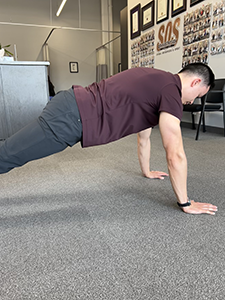
• Serratus Push-Ups (also known as Push-Ups Plus)
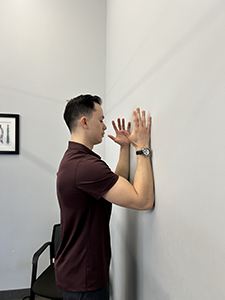
Wall Slides
Start by standing up straight facing a wall. Place your hands on the wall with your palms facing each other and your pinky fingers touching the wall. Your arms should be slightly angled out so that they move up the wall in a “V” shape. Slowly shift your arms up the wall. Slowly pull your arms back down.
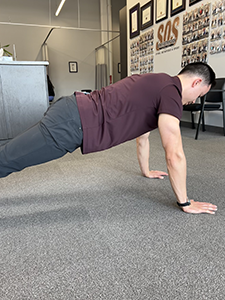
Serratus Push-Ups
Start on your hands and knees and progress to push-up position by straightening your arms and legs and bracing your abdominals. Round your upper back/shoulders, spreading your shoulder blades apart. Pull your shoulder blades back and together, flattening out your upper back.
Student life at SOS

We’re excited to welcome two physiotherapy students to the team here at Northfield! Get to know a bit about them below.
Ali
Hello, my name is Ali Shaw, I’m currently a PT student at the University of Toronto. I’ve been fortunate to be a part of SOS as a student several times: as a volunteer, as a part timer working at the admin desk, and now as a PT student (first at Belmont, now at Northfield!). It’s incredibly busy, but everyone on the team excels at teaching and mentorship, and I’ve gotten to learn so much!
Alester
Hi, I’m Alester and I’m a 2nd year physiotherapy student from Western. A fun fact about me is I travelled a lot in Asia when I was still competing for international level tennis for my home country, Hong Kong. You can find me closely following Ryan to learn more about various manual therapy techniques. I’m grateful that I have a chance to have my placement at SOS. Everyday is a rewarding experience and really deepens my understanding in the field.

Feel Better by Eating Better!
Stir-Fry Rice Bowl
Looking for a quick, healthy, and satisfying meal? This Stir-Fry Rice Bowl is packed with fresh vegetables, warm brown rice, and a perfectly poached egg for a deliciously balanced dish. This meal is both comforting and nutritious — perfect for a busy weeknight dinner!
Try it out and enjoy a wholesome, homemade meal.
Ingredients
- 1 tablespoon canola oil
- 2 medium carrots, julienned
- 1 medium zucchini, julienned
- 1/2 cup sliced baby portobello mushrooms
- 1 cup bean sprouts
- 1 cup fresh baby spinach
- 1 tablespoon water
- 1 tablespoon reduced-sodium soy sauce
- 1 tablespoon chili garlic sauce
- 4 large eggs
- 3 cups hot cooked brown rice
- 1 teaspoon sesame oil
In a large skillet, heat canola oil over medium-high heat. Add carrots, zucchini and mushrooms; cook and stir for 3-5 minutes or until carrots are crisp-tender. Add bean sprouts, spinach, water, soy sauce and chili sauce; cook and stir just until spinach is wilted. Remove from heat; keep warm.
Place 2-3 in. water in a large skillet with a high side. Bring to a boil; adjust heat to maintain a gentle simmer. Break cold eggs, 1 at a time, into a small bowl; holding bowl close to surface of water, slip egg into water.
Cook, uncovered, 3-5 minutes or until the egg whites are completely set and the yolks begin to thicken but are not hard. Using a slotted spoon, lift eggs out of water.
Serve rice in bowls; top with vegetables. Drizzle with sesame oil. Top each serving with a poached egg.